
UTSW Research Yields FDA Clearance for SP Robotic Nipple-Sparing Mastectomy

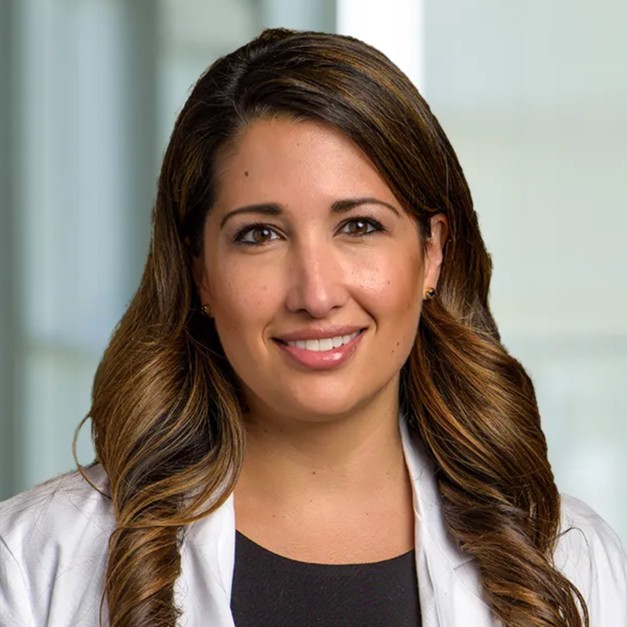
Deborah Farr, M.D.
Through clinical research, surgical innovation, and national education efforts, UT Southwestern Medical Center’s Deborah Farr, M.D., has helped establish robotic nipple-sparing mastectomy as a growing option in the U.S. for eligible patients.
She led the inaugural investigator-initiated clinical trial involving single-port robotic nipple-sparing mastectomy (SPrNSM), generating the only published data to date on its safety and effectiveness. Published in JAMA Surgery in 2024, the study reported outcomes from the trial’s initial 20 patients, providing foundational evidence for subsequent Food and Drug Administration (FDA) clearance and broader adoption of the technique.
The work also demonstrated an unexpected benefit. Many patients retained breast and nipple sensation following surgery, a result not typical with traditional mastectomy procedures.
Since publishing those findings, Dr. Farr has performed hundreds of SPrNSM procedures and emerged as a leader in the field, training surgeons across the country on an approach designed to preserve quality of life while also delivering top surgical outcomes.
“The only differences in SPrNSM compared with traditional mastectomy are the size and placement of the incision and the fact that people have sensation afterward,” said Dr. Farr, Associate Professor of Surgery at UT Southwestern Medical Center and a member of the Harold C. Simmons Comprehensive Cancer Center. “We have not had any new cancers or recurrences in the people who have had the surgery.”
Personal drive to improve patients’ long-term outcomes
Dr. Farr’s vision for a better long-term quality of life for patients after breast cancer is rooted in the experiences of her grandmother, who had a radical mastectomy decades ago that left her disfigured and experiencing lingering pain and swelling along with the complete loss of sensation in her chest.
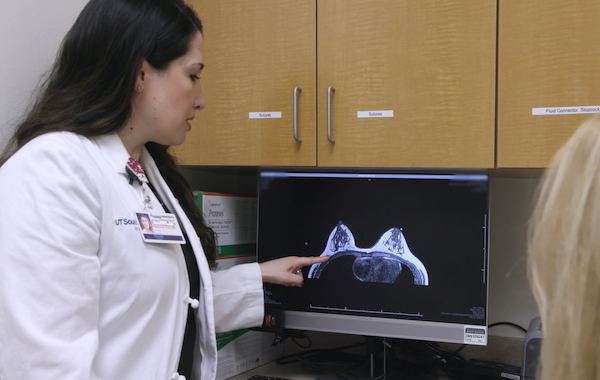
Dr. Farr reviewing breat imaging.
That memory resonated with Dr. Farr and formed her vision as a surgical oncologist: Mastectomy should not only remove cancer but also help patients move forward with the best possible quality of life.
Yet the road to achieving that goal through SPrNSM has not always been smooth.
“The FDA issued a statement in 2019 saying that no one should do single-port robotic nipple-sparing mastectomy outside of a stringent research environment,” Dr. Farr said. “All the data to that point had come from Europe and Asia. Additionally, there had been bad oncologic outcomes in other types of robotic surgeries. Because there was a paucity of data, there were concerns that we might have the same outcomes.”
SPrNSM, performed on Intuitive’s Da Vinci SP surgical platform, allows preservation of both the nipple and sensation in the breast tissue. When Dr. Farr was teaching medical students at the SIM Center, she envisioned a better way to perform mastectomy.
She traveled to Italy to observe robotic breast surgery, and later became credentialed on the Da Vinci SP platform, which facilitates precise, effective breast cancer surgery using a single, hidden incision in the patient’s underarm. Through rigorous dedication and communication about the benefits of this approach, Dr. Farr recruited enough patients to conduct a thorough clinical trial. The results sparked a foundational transformation in breast cancer care, which she is leading on the national stage.
Unprecedented research leads to FDA (510K) clearance
To date, Dr. Farr’s landmark research has earned over 20,200 views and has been cited over 60 times. Her work represents a substantial portion of the data used during the FDA’s 510(K) clearance process, which she said has helped foster acceptance of SPrNSM in the medical community.
“The FDA is stringent about doing their due diligence,” Dr. Farr said. “As I've told my story, I think people have understood that not only was my heart in the right place, but I also did this responsibly.”
In April 2026, she chaired the American Society of Breast Surgeons meeting and led the conference’s first pre-meeting course on single-port robotic mastectomy. She shared more than six years of data supporting the oncologic effectiveness of SPrNSM and the invaluable benefit of preserving the appearance and sensation of her patients’ breasts.
As national interest in robotic breast surgery grows, Dr. Farr is collaborating with Intuitive to advance awareness of SPrNSM and train surgeons across the U.S. on the procedure.
How SPrNSM is performed
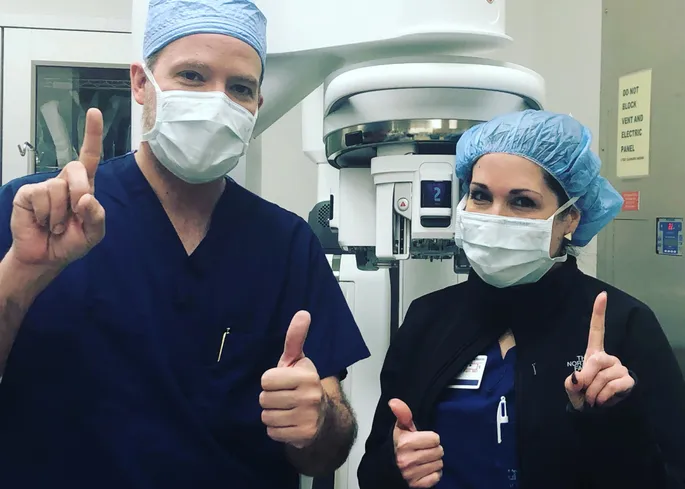
Drs. Nicholas Haddock and Deborah Farr
The robotic approach uses a single-port system inserted through a small incision in the axilla. Guided by high-definition imaging, the surgeon maneuvers robotic instruments to remove breast tissue and nearby lymph nodes under enhanced visualization.
UT Southwestern was the first hospital in the U.S. to combine Dr. Farr’s SPrNSM with a profunda artery perforator (PAP) flap reconstruction, performed by breast reconstruction surgeon Nicholas Haddock, M.D.
Dr. Haddock is a Professor of Plastic Surgery at UT Southwestern and serves as the department’s Vice Chair of Business Affairs. He is an international leader in the PAP procedure and trains surgeons around the world in the technique.
Exceptional patient outcomes with SPrNSM
Outcomes from the original clinical study data were significant. Across 20 patients aged 29-63 who had bilateral SPrNSM, there were no immediate surgical or cancer-related complications. After surgery, 95% of patients retained skin sensation on the breast, and 55% retained nipple sensation.
The FDA continues to review outcomes data submitted by Dr. Farr's team. Over the six years since the trial began, clinical results have consistently shown good oncologic outcomes and sensory preservation with SPrNSM.
Several of Dr. Farr’s patients have taken to social media to spread the word about the procedure, UT Southwestern’s exceptional patient care, and Dr. Farr’s surgical expertise. Approximately half of Dr. Farr’s SPrNSM patients currently come from outside Texas for treatment – a testament to patient satisfaction and excellent oncologic outcomes.
"SPrNSM was piloted at UT Southwestern," Dr. Farr said. "The women who traveled to Dallas to have the surgery with us brought the program to life."
Multidisciplinary breast cancer care for your patients
The success of the SPrNSM program reflects a highly coordinated, cross-disciplinary commitment involving breast surgical oncologists, breast reconstruction surgeons, anesthesiologists, specialized nurses, and surgical technologists.
Herbert Zeh III, M.D., former Professor and Chair of the Department of Surgery at UT Southwestern, was instrumental in collaborating with Dr. Farr to raise internal awareness of SPrNSM and refine surgical protocols as the procedure developed. The program has also relied on robust clinical research infrastructure to support trial enrollment, data collection, and FDA submission protocols.
SPrNSM gives eligible patients with breast cancer freedom of choice in an otherwise overwhelming scenario. For Dr. Farr, the goal remains consistent: to deliver excellent cancer treatment while advancing surgical techniques that support long-term health and quality of life for patients after breast cancer.
“This program worked because we have such a great team,” Dr. Farr said. “It was a mountain of things to accomplish, and I'm really proud that we were able to do it here.”