
First North Texas Patients Receive New Single-Port Robotic Surgery for Lung Cancer at UT Southwestern

The new single-port (SP) robotic approach at UT Southwestern is part of a broader precision thoracic oncology program that integrates advanced imaging, minimally invasive surgery, and multidisciplinary lung cancer care.
Approximately 24% of lung cancers are identified at an early stage when the disease is contained within the lung. In most cases, early-stage lung cancer is highly treatable, particularly when a multidisciplinary team guides the patient’s care.
In March 2026, thoracic surgeons at UT Southwestern Harold C. Simmons Comprehensive Cancer Center became the first team in North Texas to offer single-port robotic-assisted thoracoscopic lobectomy for early-stage lung cancer.
At the time of this article, the team had completed 10 pulmonary resections, including lobectomies and segmentectomies, with the single-port surgical system, which was approved by the Food and Drug Administration in 2024 for urologic and general thoracoscopic surgical procedures (based on findings of the national single-port thoracic trial).
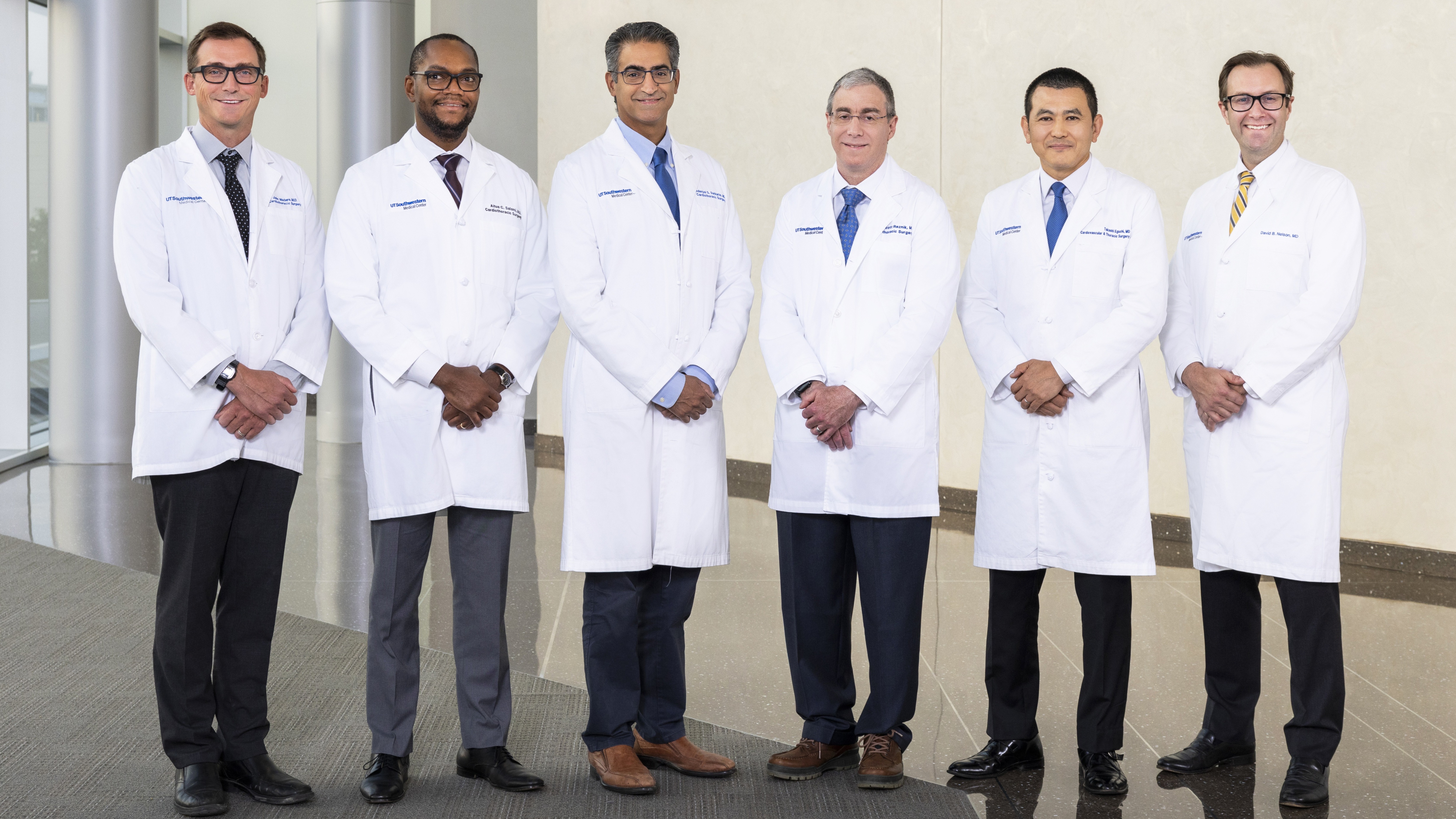
Thoracic surgeons, from left to right: John Waters, M.D., Aitua Salami, M.D., M.P.H., Inderpal S. Sarkaria, M.D. (Chief), Scott Reznik, M.D., Takashi Eguchi, M.D., Ph.D., and David. B. Nelson, M.D.
This technology is an integral part of UT Southwestern’s accelerated treatment pathway for early-stage lung cancer patients, which advances them from diagnosis to treatment weeks faster than those in a standard treatment timeline – often with a shorter, more comfortable post-operative recovery.
“Adopting this new technology is a welcome extension of our comprehensive suite of treatment options for early-stage lung cancer,” said Takashi Eguchi, M.D., Ph.D., FCCP, FACS, Assistant Professor and thoracic surgeon in the Department of Cardiovascular and Thoracic Surgery at UT Southwestern.
The single-port approach supports the thoracic oncology team’s goal of providing each patient with an efficient, complete, and timely path to treatment.
Small incision, advanced imaging
UT Southwestern’s thoracic surgeons who perform this unique surgery include Dr. Eguchi and Aitua Salami, M.D., M.P.H., Assistant Professor in the Department of Cardiovascular and Thoracic Surgery at UT Southwestern. They use advanced imaging and 3D reconstruction technology to perform precise, efficient surgeries. Near-infrared technology, for example, allows the team to visualize small or hidden lung nodules that may go undetected with traditional white light imaging.
This technology opens the door to more personalized, much earlier lung cancer treatments than were previously possible.
“Each patient has unique anatomy and tumor characteristics, so our surgical planning must be individualized,” Dr. Eguchi said. “We routinely use three-dimensional imaging to tailor safe procedures to each patient.”
Using the da Vinci SP surgical system, the surgeon makes a single incision about an inch long below the rib cage and inserts a lighted catheter equipped with precise instruments and a flexible, high-definition camera that provides real-time visualization of the surgical field. The system translates the surgeon’s hand movements to deftly remove the tumor and a margin of tissue around it with enhanced precision.
Accelerated treatment timeline for early lung cancer
Thoracic oncology specialists at Simmons Cancer Center are redefining the treatment timeline for early-stage lung cancer. By combining the power of minimally invasive surgical technologies with their collaborative expertise, they are reducing the diagnosis-to-treatment period from several weeks or months to as little as several days in selected patients.
“When we see patients with suspicious lung nodules, we implement an accelerated treatment pathway,” said Dr. Salami. “This streamlined process allows us to move patients from nodule identification to definitive treatment within a few days, compared to several weeks or months at lower-volume centers.”
At UT Southwestern, thoracic surgeons and interventional pulmonologists work within a comprehensive service line to streamline this process. They meet regularly as a thoracic tumor board, which also includes medical and radiation oncologists rounding out the full multi-disciplinary team, to discuss the nuances of each case and develop an individualized treatment plan for every patient.
Benefits of SP lobectomy
For carefully selected patients, using the SP technique can shorten their hospital stay and reduce the risk of post-operative complications.
“Chest surgery, even with some robotic platforms, often requires access through the ribs, and there are nerves under each rib,” Dr. Salami said. “With SP robotic resection we access the lung below the ribcage instead of through the chest, and there tends to be much less pain for patients in the recovery period.”
Along with early-stage lung cancer treatment, Simmons Cancer Center is using the single-port surgery approach for certain urologic and breast cancers with the goal of expanding its use to treat additional cancer types.
Refer a Patient
We are committed to collaborating with referring physicians and welcome your referrals for patients with lung nodules, lung cancer, or other thoracic surgery needs. Our thoracic surgeons are located at UT Southwestern locations across the Dallas-Fort Worth Metroplex (including Dallas/Medical District, Dallas/RedBird, Fort Worth, Coppell, and Frisco.) Please call us directly at 214-645-7700 to discuss or refer a patient.